|
I'm sorry but this page is
not yet translated.
It will be completed by spring 2025 at the latest
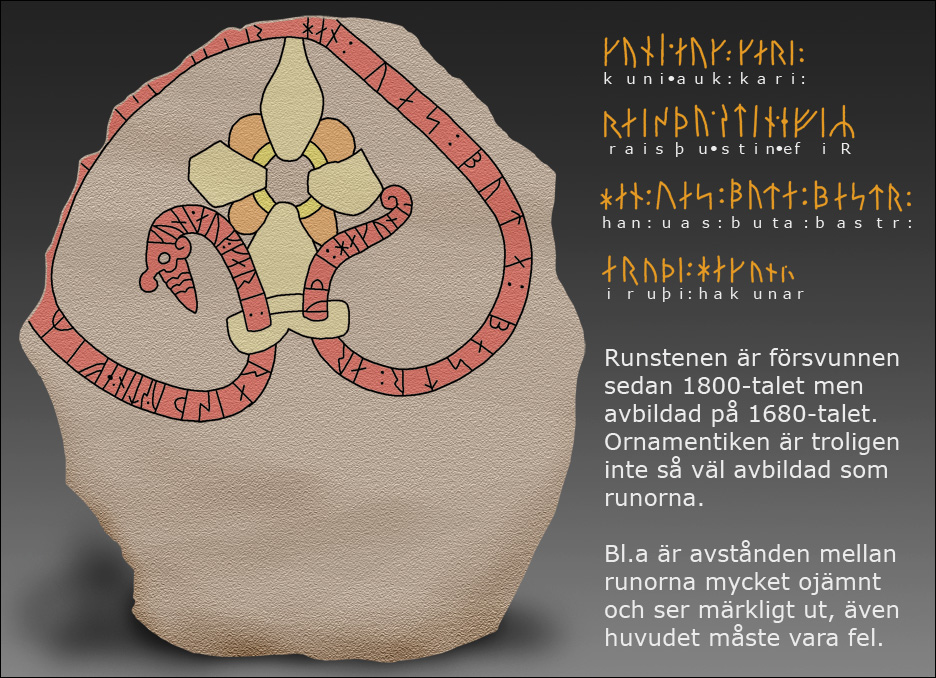
Runinskrift
Gunni och Kåre reste sten efter ...r
Han var den bästa av bönder i Håkons rod
Kuni · auk : Kari : raisþu
· stin · efiR _ …r :
Han
: uas : buta : bastr : i ruþi : hakunar
Historik
Den nu försvunna runstenen avritades 1676 av
Leitz.
Märkliga detaljer som utformningen av drakens
huvud, korsets förvrängda form och det mycket ojämna
avstånden mellan runorna gör att jag har svårt att tro att
Leitz verkligen såg runstenens ornamentik tydligt.
Runinskriftens del "bästa av bönder i Håkons
rod" är riktigt spännande för då har runstenen koppling på
något sätt med runsten U 11
i Hovgården som också nämner rod "... ToliR bryte i rod.."
Var finns runstenen i dag?
Jag ser tre alternativ.
1). Runstenen ligger omkullfallen med
ristningen mot marken och väntar på att bli återfunnen.
Tyvärr är det här inte det mest troliga men mest önskvärda.
2). Den har använts som bro över dike
eller/och sedan hamnat under mark vid täckdikning. (När man
först dränerar diket och sedan täcker med jord för att få
större och sammanhängande åker). Nog det mest troliga
alternativet men då lär det nog dröja länge innan den blir
återfunnen.
3). Den har krossats till mindre bitar
som sedan använts som byggnadsmaterial till skorstensstock,
källare och husgrund. Det näst mest troliga men ett av de
vanligaste sätten vi förlorat runstenar på. Till runstenens
fördel är att det ändå finns gott om naturlig kantig sten i
området och att det oftast dyker upp fragment av den
förstörda runstenen eller kan ses synliga i byggnationer men
inga sådana har ännu hittats efter U 16 så det finns hopp om
att den ligger hel någonstans i området.
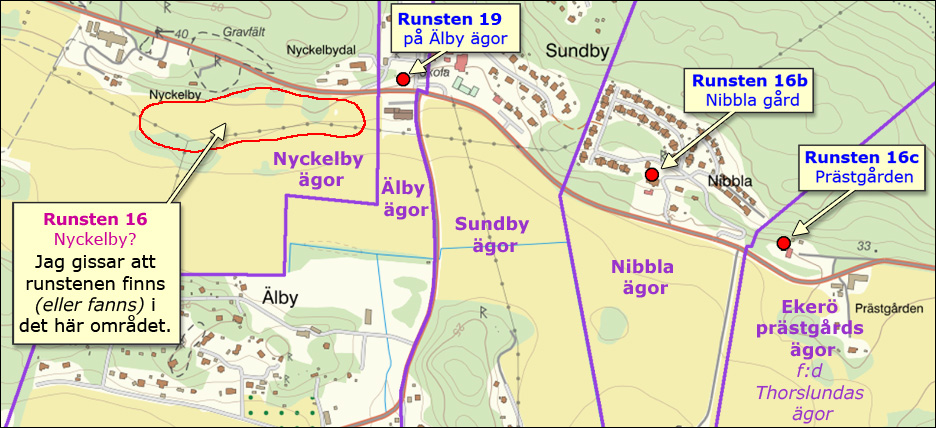
Var ska vi leta?
I Upplands runinskrifter finns några få
ledtrådar... tyvärr lite olika men det är alltid något.
1630 - Bureus anger platsen: "På
Ekerön vid Nybla".
1676 - Hadorph säger att den finns
vid: "Nybbele vid allmänna vägen." Han tillägger: "här
ovanför finns många märkliga ättehögar...".
1680 - Peringskiöld: "den står
väster om prästgården"
1850: Dahlgren säger att den låg
omkullfallen på Älby ägor väster om landsvägen. Han säger
även att tidigare uppgifter om att den finnas på Nibbles
ägor är felaktiga.
Länkar
Upplands runinskrifter > Sidan
24
Runor > Riksantikvarieämbetet
kalle@runristare.se
If you want to be of help or have a question.
ALL
RUNESTONES
Ekerö
municipality
ADELSÖ >
has 5
known runestones
BIRKA >
has fragments from 9 known
runestones
MUNSÖ >
has 3 or
4 known runestones
EKERÖ >
has 11 known runestones
FÄRINGSÖ
>
has 27 known runestones
LOVÖ >
has 8 known runestones
|